
Oils and Tinctures
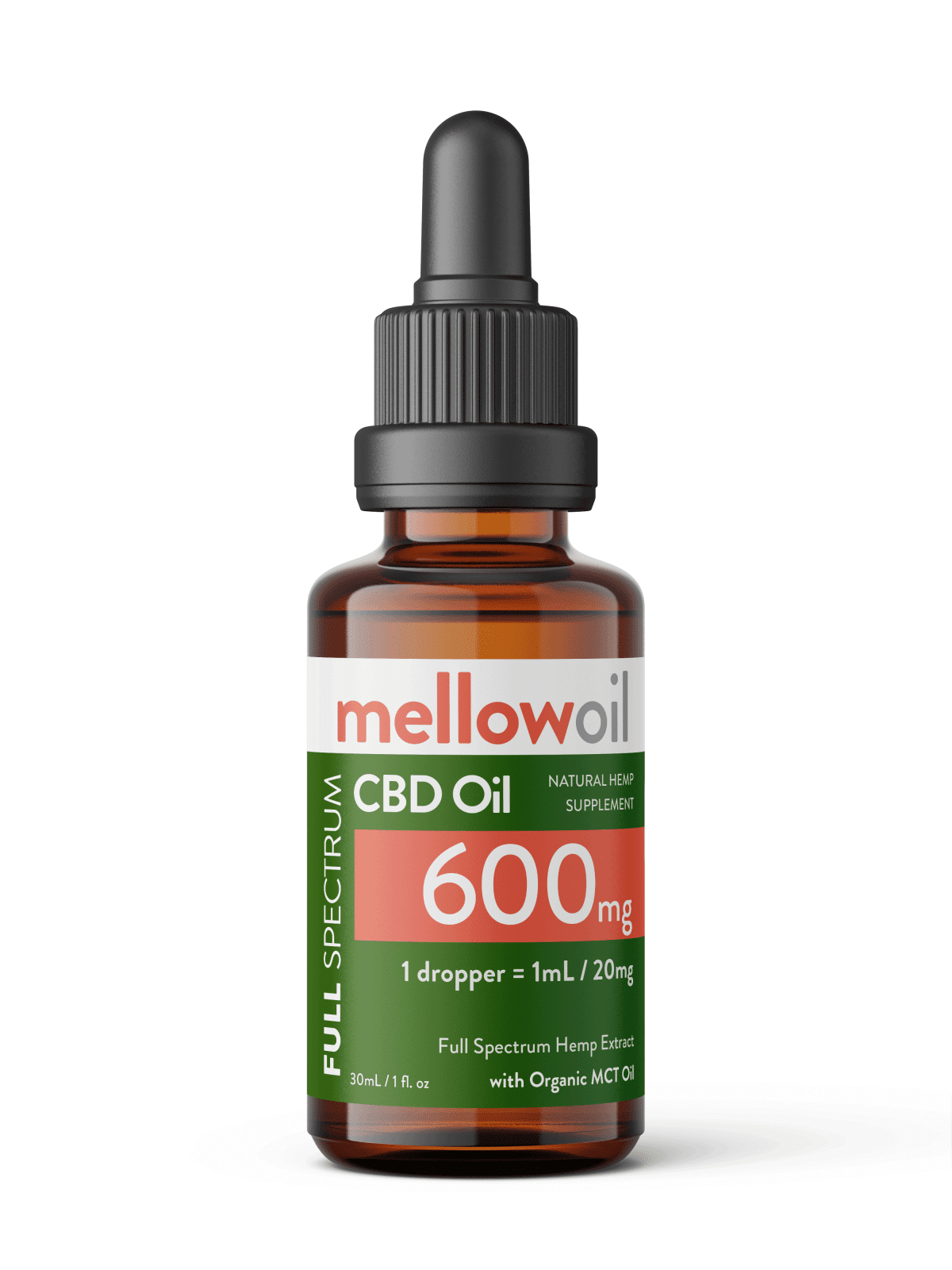
Mellow Oil Full Spectrum CBD Oil 30ml with 600mg Cannabidiol / 20mg CBD per mL
★★★★★123
$30.00 CAD
Weight-based CBD dosing chart for Canadians. Find your starting dose in mg based on body weight, use case, and product type — plus a free calculator to personalize it further.
The most accurate way to find your starting CBD dose is to base it on body weight. A 120-pound person and a 220-pound person metabolize CBD differently — a flat dose recommendation ignores that entirely. This guide gives you a weight-based dosage chart, explains how to adjust for your use case, and walks you through how to apply it whether you're using a tincture, capsule, or isolate powder.
Quick answer: Start with 0.2–0.3 mg of CBD per pound of body weight (or 0.5–0.7 mg per kg) once daily. For a 150 lb person, that's 30–45 mg per day as a moderate starting dose. Drop to 0.1 mg/lb for a conservative start, or go up to 0.5 mg/lb for therapeutic use cases like chronic pain or severe sleep disruption. Wait 5–7 days at each dose level before adjusting.
Want the personalized version? Use the free Mellow CBD Dosage Calculator → — enter your weight, goal, and experience level and get a specific recommendation in 30 seconds.
CBD is processed through the endocannabinoid system and metabolized in the liver. Both of those processes scale roughly with body mass — the same way medication dosing works in clinical settings. A larger person has more tissue to distribute CBD through and a larger metabolic load, meaning a fixed dose produces a weaker effect per unit of body mass.
This isn't controversial: the World Anti-Doping Agency, several Phase II/III clinical trials (including the Epidiolex trials for epilepsy), and Health Canada's guidance all frame CBD dosing in terms of mg/kg body weight. The retail market tends to ignore this, defaulting to flat-dose recommendations that underserve large users and overserve small ones.
Weight isn't the only variable — tolerance, sensitivity, use case, product bioavailability, and time of day all matter — but it's the best single starting point when you have no prior CBD history to guide you.
Use this table to find your weight bracket and starting dose range. "Low" is a conservative first week. "Moderate" is where most users settle after the first two weeks. "High" is for therapeutic use under guidance.
| Body Weight | Low Dose | Moderate Dose | High Dose |
|---|---|---|---|
| Under 100 lbs (45 kg) | 10 mg | 15–20 mg | 25–30 mg |
| 100–130 lbs (45–59 kg) | 15 mg | 20–25 mg | 30–40 mg |
| 131–160 lbs (60–73 kg) | 20 mg | 25–35 mg | 40–55 mg |
| 161–190 lbs (74–86 kg) | 25 mg | 35–45 mg | 55–70 mg |
| 191–220 lbs (87–100 kg) | 30 mg | 40–55 mg | 65–85 mg |
| 221–250 lbs (101–114 kg) | 35 mg | 50–65 mg | 80–100 mg |
| Over 250 lbs (114+ kg) | 40 mg | 60–75 mg | 90–120 mg |
Notes:
The chart gives you a target mg amount. How you get there depends on your product:
CBD Oil / Tincture Most tinctures are labeled in mg per mL. Divide your target dose by the concentration to get your volume. For example: a 2400 mg / 30 mL tincture = 80 mg/mL. To take 25 mg, you'd use about 0.3 mL (roughly 6 drops from a standard dropper).
CBD Capsules Easier — each capsule has a fixed mg amount (typically 30 mg for Mellow softgels). Round your target dose to the nearest capsule. One 30 mg capsule is appropriate for most 130–190 lb moderate users.
99% CBD Isolate Powder Isolate is 99%+ pure CBD, so 1 mg of powder = ~1 mg of CBD. Use a precision scale (0.01 g accuracy). Common approach: weigh your dose, dissolve in coconut or MCT oil at home, and take sublingually or add to food.
CBD Gummies Fixed dose per piece, typically 20–40 mg. CBD gummies are easy for consistency but less adjustable for fine-tuning. Start with half a gummy if your target dose is under 20 mg.
Body weight gets you to your starting zone — your use case tells you where in that zone to start.
Sleep support: Start on the higher end of the moderate range, taken 30–60 minutes before bed. CBD + CBN combinations (like Night Gels) show better results than CBD alone for sleep latency. A 160 lb person starting for sleep might use 35–40 mg rather than the 25 mg conservative start.
Anxiety and stress: Use the low-to-moderate range, split across morning and evening doses. High doses can cause drowsiness, which is counterproductive for daytime anxiety management. Most users in the 130–190 lb range do well at 20–30 mg/day total, split.
Chronic pain and inflammation: This is where higher doses are most justified. Studies on CBD for pain use doses up to 600 mg/day in clinical settings, but most daily users see results between 50–100 mg/day for moderate pain. Start moderate; move up in 10 mg increments weekly.
General wellness: Stick to the low range. The goal here is subtle endocannabinoid system support, not acute symptom management. 10–25 mg/day is appropriate for most adults regardless of weight when the goal is general balance.
Whatever dose the chart suggests, follow this protocol for your first two weeks:
Week 1: Take the low-dose amount. One dose per day, same time each day. Note any changes in sleep, mood, or pain. Don't expect dramatic effects — CBD builds up over several days.
Week 2: If you noticed minimal effect, move to the moderate dose. If you noticed uncomfortable side effects (drowsiness, loose stools, appetite changes), drop back 5 mg and hold there.
Week 3+: If moderate dose is working, stay. If you've been consistent for three weeks and still see no effect, consider switching products (isolate users may benefit from full-spectrum; tincture users may want faster-absorbing softgels).
Most people who "tried CBD and it didn't work" were either: (a) under-dosed for their weight, (b) inconsistent, or (c) using a product with inaccurate CBD content. Third-party lab testing is the only way to verify potency.
Dosing math only works if your product actually contains what the label says. In Canada, Health Canada requires licensed producers to meet label accuracy standards — but not all CBD products sold online meet this bar. Always buy from brands that publish third-party certificates of analysis (COAs) from an accredited lab. COAs verify potency (the mg/mL or mg per serving is accurate) and purity (no pesticides, heavy metals, residual solvents).
All Mellow products are third-party tested. You can request COAs for any product via our contact page.
A practical starting formula for Canadians is 0.5–0.7 mg per kg of body weight per day. This puts a 70 kg (154 lb) person at approximately 35–49 mg/day as a moderate dose. For a conservative first-week start, use 0.25 mg/kg. For chronic pain or severe sleep disruption, some users move up to 1–2 mg/kg under practitioner guidance.
Not necessarily — it depends on your weight. For a person under 120 lbs, 25 mg is on the higher end of the moderate range and may cause drowsiness. For someone 160+ lbs, 25 mg is a conservative-to-moderate starting dose. Use the weight chart above to contextualize any flat mg recommendation you see.
Yes. CBD is fat-soluble and stored in adipose (fat) tissue. People with higher body fat percentages may accumulate CBD more readily and have it detectable in the body for longer. For most Canadians, CBD clears in 2–5 days after single use, and 10–15 days after consistent daily use. This is relevant if you're subject to drug testing — though standard drug tests screen for THC, not CBD, and zero-THC CBD isolate products carry no THC detection risk.
Not immediately. If you're one week into a dose and feel nothing, first confirm you're taking it correctly (sublingual hold for 60–90 seconds for tinctures; with food for capsules), confirm the product's COA, and confirm you've been consistent. If all of those check out and you've had no effect at the low dose after 7–10 days, move up to the moderate range for your weight. Jumping to high doses immediately is the most common dosing mistake.
CBD has a very wide therapeutic window. A 2011 review in Current Drug Safety concluded that chronic CBD use up to 1,500 mg/day was well-tolerated in humans. However, high doses can cause side effects: drowsiness, appetite changes, diarrhea, and interactions with certain medications (CBD inhibits CYP450 liver enzymes). If you take prescription medications, talk to your doctor before using CBD above 50 mg/day.
CBD oil tinctures give the most precise control — you can adjust by 5 mg increments by changing volume. Capsules are easier for consistency but come in fixed doses. If you're new and trying to find your exact dose, start with a tincture, then switch to capsules once you know your target mg.
Weight-based dosing takes the guesswork out of CBD. Use the chart, start at the low end for your weight bracket, give it 5–7 days before adjusting, and match your dose to your use case. Most Canadians find their effective dose within 2–3 weeks of this approach.
For a personalized recommendation that also factors in your use case and experience level, use the free Mellow CBD Dosage Calculator →
Author: Mallory Milne has worked in Canadian cannabis wellness since legalization. She holds a certificate in Cannabis Health and Wellness and writes for Mellow's education series.
The information in this article is for educational purposes only and is not intended as medical advice. Always consult with a healthcare professional before starting any new supplement, including CBD products.
Sources & Further Reading
Oils and Tinctures
Oils and Tinctures

Oils and Tinctures
CBD isn't a weight loss drug — but there's real science behind how it may support better sleep, lower stress, and a healthier metabolism. An honest look at the evidence.

CBD quiets a racing mind; CBN promotes physical drowsiness. Together, they offer a non-habit-forming natural sleep approach. Here's how they work, how to dose them, and what to look for in a product.

There's no universal CBD dose. Here's how to find the right amount for your body, your goals, and your product — with a simple starting framework any Canadian can follow.