
Oils and Tinctures
Mellow Oil Full Spectrum CBD Oil 30ml with 1200mg Cannabidiol / 40mg CBD per mL
★★★★★★81
$52.00 CAD
Everyone knows hemp is a plant with many uses, but few realise just how complex its inner workings really are. Across its leaves, roots, and stems, hemp has a design so intricate that its root system

Everyone knows hemp is a plant with many uses, but few realise just how complex its inner workings really are. Across its leaves, roots, and stems, hemp has a design so intricate that its root system can reach depths of up to 2.5 metres underground. Many assume hemp’s value is all about fibres or CBD oils. The truth is, its unique anatomy holds the secret to why it thrives in tough conditions — and why experts think it could change everything from medicine to construction.
TL;DR: Hemp’s anatomy — deep taproots, fibrous stems, and compound leaves — makes it one of the most versatile plants on earth. Its root system can reach 2.5 metres deep, supporting soil health and carbon capture. Understanding how each part works helps explain its growing role in textiles, construction, health products, and sustainable agriculture.
| Takeaway | Explanation |
|---|---|
| Hemp anatomy supports diverse applications | Understanding the plant’s structure opens up potential in agriculture, medicine, and industry. |
| Optimised crop breeding improves quality | Detailed anatomical knowledge lets farmers develop specific hemp strains with desired characteristics. |
| Roots and stems improve environmental sustainability | The deep taproot aids soil restoration and carbon sequestration, boosting ecological practices. |
| Advanced materials produced from hemp | Hemp’s fibrous structure supports sustainable textiles and eco-friendly construction materials. |
| Health benefits stem from unique composition | Hemp contains essential nutrients and compounds that can promote wellness and offer therapeutic potential. |
Hemp plant anatomy is the intricate biological structure of Cannabis sativa — a versatile botanical species with remarkable complexity. Understanding this anatomy helps researchers, farmers, and curious users appreciate how each part of the plant contributes to what it can do.
To give a clear picture, the table below summarises the key structural components of the hemp plant and their primary functions.
| Anatomical Component | Primary Function | Key Feature |
|---|---|---|
| Root System | Nutrient absorption and plant stabilisation | Deep taproot with lateral branching |
| Stem | Structural support; conducts water and nutrients | Vascular tissues (xylem and phloem) |
| Leaves | Photosynthesis and energy generation for plant growth | Compound, serrated, palmately arranged |
| Flowers | Reproduction and cannabinoid/seed production | Dioecious structures on male and female plants |
At its core, hemp plant anatomy is made up of several key structural elements that define its growth, development, and biological performance. These components work together to enable the plant’s survival, reproduction, and resource management. Research from Purdue University highlights the sophisticated design of hemp’s botanical architecture.
The primary anatomical components include:
Hemp’s anatomy shows a remarkable ability to adapt, with each feature built for solid environmental interaction. The plant’s cellular structures support efficient water management, nutrient transportation, and resilience in tough conditions. Its root system, for instance, can push deep into soil, pulling up minerals and keeping the plant stable across varied growing environments.
The stem’s vascular tissues create channels for water and nutrient movement, while the leaf structures get the most out of available sunlight. This biological design lets hemp grow well in varied climatic conditions — making it an extraordinarily versatile species with real potential across agricultural and industrial uses.
Hemp plant anatomy isn’t just scientific curiosity. It’s a field of understanding with practical implications across agriculture, medicine, and sustainable manufacturing. How do you choose the right hemp product if you don’t understand what the plant actually does? That’s where this knowledge gets useful.
Understanding hemp plant anatomy makes more precise agricultural strategies possible. Research published in the National Institutes of Health shows how detailed anatomical knowledge helps researchers develop specialised hemp varieties with specific characteristics. This scientific approach turns hemp from a generic crop into a precision-engineered resource.
Key economic advantages of understanding hemp anatomy include:
Hemp’s complex anatomical structure offers strong potential for technological and medical innovation. Its unique cellular composition supports the development of advanced biomaterials, sustainable textiles, and potentially meaningful medical treatments. By mapping and understanding each anatomical component, researchers can design targeted approaches that tap into hemp’s inherent biological capabilities.
Detailed anatomical research also informs our overview of hemp’s health benefits, showing how scientific understanding translates into practical wellness applications. The relationship between hemp’s physical structure and its therapeutic properties continues to drive cutting-edge research.
Hemp plant structure is a sophisticated biological design that supports remarkable adaptability across diverse environmental conditions. Each anatomical component plays a role in the plant’s survival, reproduction, and resource management.
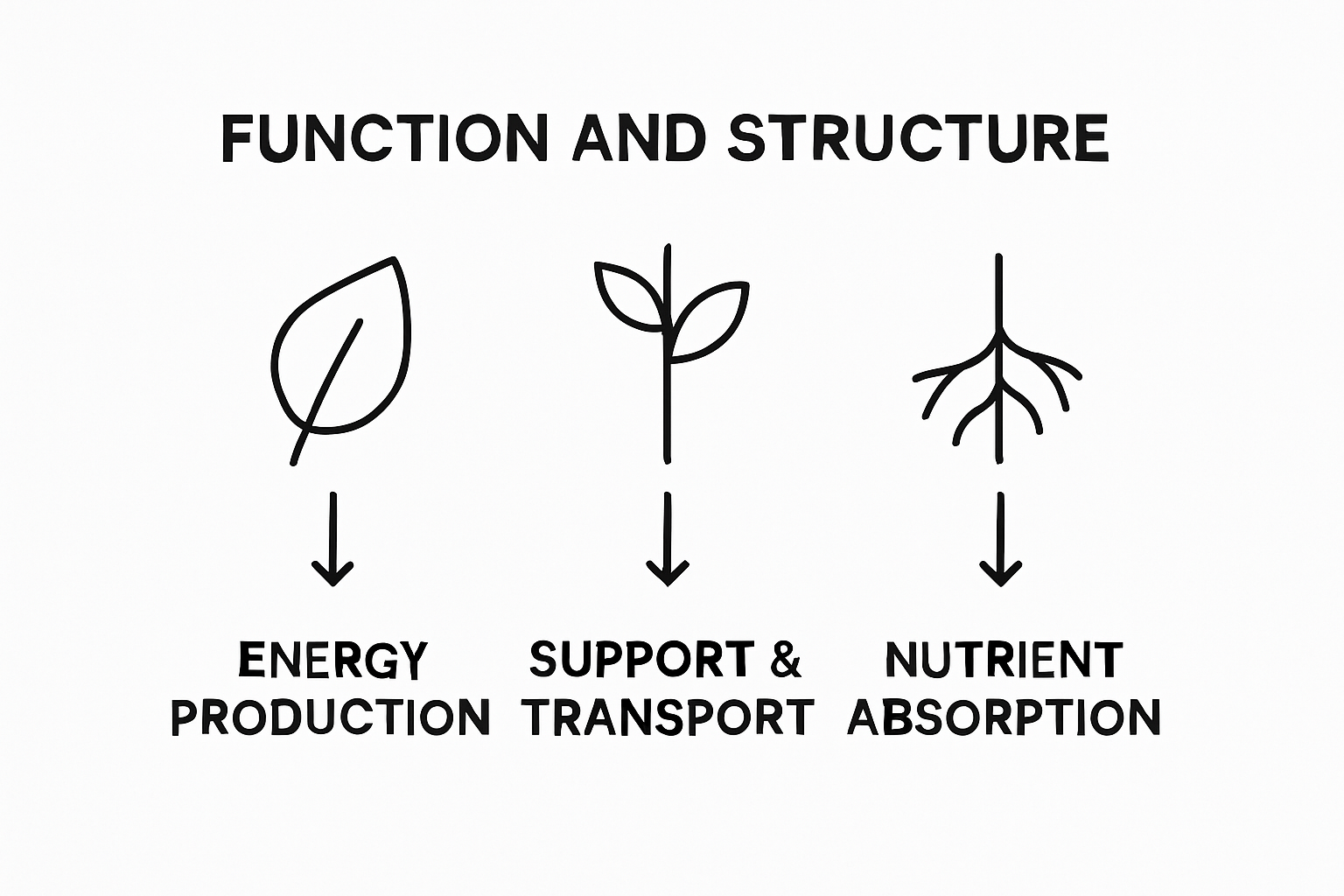
Research from hemp botanical experts shows that hemp plants have a strong root and stem system built for exceptional performance. The root structure typically features a solid taproot with lateral branching, allowing deep soil penetration and efficient nutrient absorption. Hemp’s stem contains intricate vascular tissues — xylem and phloem — creating channels for water, mineral, and nutrient movement.
Key structural characteristics of hemp roots and stems include:

Hemp leaves have a distinctive compound structure, typically featuring 5–9 serrated leaflets arranged in a palmately divided configuration. These leaves aren’t just photosynthetic organs — they’re sophisticated biological interfaces that manage energy production and environmental interaction. The leaf margins and surface textures are specifically adapted to hold moisture and absorb solar energy efficiently.
Reproductively, hemp plants are dioecious, meaning male and female reproductive structures exist on separate plants. This unique feature allows for precise genetic specialisation and controlled breeding strategies.
Learn more about cannabinoid variations that come from these complex reproductive mechanisms, which significantly influence the plant’s therapeutic and industrial potential.
Hemp plant anatomy serves as a versatile biological platform, making transformative applications possible across multiple industrial sectors. Understanding the structural characteristics of Cannabis sativa helps researchers and manufacturers find innovative solutions for sustainable development and technological progress.
The table below compares the main industrial and environmental applications of hemp plant anatomy, showing how different anatomical features support these developments.
| Application Area | Relevant Anatomical Feature | Impact or Benefit |
|---|---|---|
| Textile Production | Bast fibres in the stem | Durable, sustainable fabrics |
| Construction Materials | Hurd fibres in the stem | Eco-friendly building components |
| Biofuel Development | Plant biomass | Renewable energy source |
| Soil Restoration | Deep taproot system | Improves soil structure, enables remediation |
| Carbon Sequestration | Extensive root system | Captures and stores atmospheric carbon |
| Phytoremediation | Complex root and cellular structures | Removes contaminants from soil |
Research from the USDA Agricultural Research Service shows hemp’s strong potential for creating diverse industrial materials. The plant’s unique anatomical features — particularly its fibrous stem structure — support production of sustainable textiles, construction materials, and advanced composites.
Key industrial applications from hemp anatomy include:
Hemp’s solid root and cellular structures contribute meaningfully to environmental sustainability. The deep taproot system helps with soil restoration, carbon capture, and phytoremediation — changing what’s possible in agricultural practice. These anatomical characteristics make hemp a genuinely useful tool for addressing environmental challenges. Worth trying in your region? In our experience, farmers who’ve added hemp to crop rotations report real improvements in soil quality over time.
Our overview of hemp’s health benefits also shows how the plant’s complex anatomical composition translates into potential therapeutic applications. From its cellular metabolism to its reproductive mechanisms, hemp brings together biological efficiency and industrial potential in a way few other crops can match.
Understanding hemp plant anatomy isn’t just interesting — it opens up practical insights for personal health, environmental sustainability, and technological innovation. By looking at the biological mechanisms of Cannabis sativa, we can find potential solutions to real challenges across multiple areas.
Scientific research shows that understanding hemp’s complex anatomical structure helps with the targeted development of therapeutic interventions. The plant’s unique cellular composition contains compounds with real potential for human wellness — from nutritional supplements to possible medical treatments.
Key health benefits from hemp anatomy include:
Hemp’s anatomical structure provides some solid environmental advantages. Its deep root system helps restore soil, supports carbon capture, and enables phytoremediation processes. By understanding these biological mechanisms, researchers can develop better strategies for ecological restoration and sustainable agriculture.
Learn more about hemp’s health benefits and see how this plant’s anatomy brings together biological complexity and practical human wellness. From its cellular metabolism to its reproductive mechanisms, hemp keeps demonstrating real promise across science and everyday application.
Curious about how hemp’s intricate anatomy can affect your health and wellbeing? You’ve just seen how each part of the Cannabis sativa plant plays a role in nutrient absorption, cannabinoid production, and environmental resilience. But knowing about advanced root systems, potent flower structures, and leaf membranes only matters if you can actually benefit from what hemp offers. Many Canadians are looking for trusted sources for high-quality CBD oils and extracts — and struggling to find products that genuinely reflect the science behind hemp’s natural complexity.

At Mellow, we source from hemp plants with well-optimised anatomy and formulate for purity, consistency, and real therapeutic quality. Explore our CBD selection to find solutions that take the science seriously. Ready to bring the science of hemp plant anatomy into your daily routine? Visit BuyMellow now and turn your understanding into meaningful results. And dig into how full-spectrum cannabinoids work with our guide to cannabinoid variations.
Hemp plant anatomy primarily consists of the root system, stem, leaves, and flowers. Each component plays a role in the plant’s growth, development, and overall functionality.
Understanding hemp anatomy lets farmers develop specific agricultural strategies, improve crop breeding, boost plant resilience, and use resources more efficiently — ultimately leading to more targeted cultivation practices.
The root system of hemp is essential for nutrient absorption and plant stability. Its taproot and lateral branching allow deep soil penetration, which helps the plant thrive in various environmental conditions.
Hemp’s unique anatomical features, particularly its fibrous stem, support the production of sustainable materials such as textiles and construction components — backing eco-friendly manufacturing practices and innovation.
The information in this article is for educational purposes only and is not intended as medical advice. Always consult with a healthcare professional before starting any new supplement, including CBD products.
Sources & Further Reading
Oils and Tinctures

Oils and Tinctures
Oils and Tinctures

CBD, CBN, or melatonin for sleep in Canada? Compare onset, duration, dependency risk, and daily suitability. Research-backed guide with dosage starting points.
CBN isolate is a pure, THC-free cannabinoid extract gaining traction in Canada for sleep support. Learn what it is, how it differs from CBD, and what to look for when buying.

Find the cheapest CBD oil in Canada without sacrificing quality. 2026 price comparison, value tips, and lab-tested picks from 2 CAD.